


Get your free PDF
Masters of tone, technique, and expression
On March 8th we celebrate Women’s Day, and we want to do our part by explaining how two women were highly influential in the early history of the saxophone.
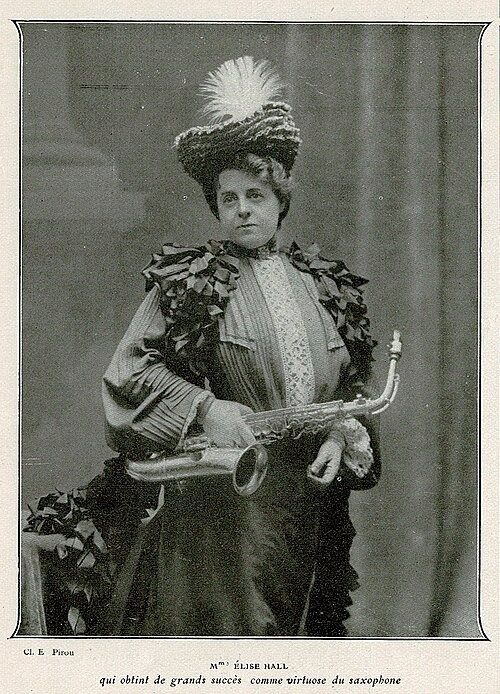
If I ask you to imagine a saxophonist, what do you see? Probably a man wearing a hat in a smoky jazz club in New York, or perhaps the silhouette of Adolphe Sax fighting with half of Paris over his patents. But reality is much more interesting. The saxophone, both in its classical facet and in its jazz roots, owes its survival and dignity to two absolutely exceptional women: Elise Hall, the deaf patron who forced the great composers to look at the instrument, and Kathryne Thompson, the virtuoso who wrote the instruction manual for jazz when nobody even knew what to call it.
Today we are not talking about inspiring muses. We are talking about women who took control, put up the money, wrote the methods, and took to the stage when society told them their place was in the living room embroidering cushions. Get ready to discover the hidden history of the saxophone.
1. Elise Hall: “The saxophone lady” who bought posterity (and pissed off Debussy)
To understand the magnitude of Elise Hall, we must travel to late 19th-century Boston. Imagine a straitlaced, puritanical, and classist society: the “Boston Brahmins.” Into this scene steps Elizabeth Boyer Coolidge (later Elise Hall), born in Paris in 1853, the daughter of a wealthy, cultured, and well-connected family.
Elise wasn’t destined to be a musician. She was destined to be a trophy wife. She married Dr. Richard J. Hall, a prestigious surgeon (famous for performing the first appendectomy in the United States). The couple lived a life of luxury between New York and Santa Barbara, California. But fate has a macabre sense of humor.
The diagnosis that changed music history
Midway through her life, Elise contracted typhoid fever. The disease left severe sequelae: progressive hearing loss that would leave her practically deaf. Her husband, concerned about her lung health and hearing, gave her a medical recommendation that today seems surreal but was providential: “Darling, you should play a wind instrument. The air pressure will help open your Eustachian tubes and improve your hearing.”
Obviously, playing the saxophone doesn’t cure deafness. But Dr. Hall, without knowing it, had just gifted the world the first great classical saxophone soloist. Elise, who was already nearly 50 years old, wasn’t satisfied with playing the flute or the clarinet. She chose the saxophone, an instrument that at the time was considered vulgar, hybrid, military, and definitely “unfit for a lady.”
Elise was widowed shortly after (irony of ironies, her surgeon husband died of acute appendicitis), inheriting an immense fortune. Deaf, rich, and alone, she decided that if society wouldn’t give her a space, she would buy one.
The Boston orchestral club: A custom made orchestra
Elise Hall didn’t want to play alone in her dining room. She wanted to play with an orchestra. But professional orchestras didn’t admit women, let alone saxophonists. The solution? She founded her own orchestra: the Boston Orchestral Club (1899-1912).
It was an “amateur orchestra” only on paper. Thanks to her money, Elise hired the best musicians from the Boston Symphony Orchestra to bolster the ranks, rented the best halls, and, most importantly, appointed herself president and principal soloist. For over a decade, this deaf woman stood before audiences, sax in hand, defying all the conventions of her time.
The war with Claude Debussy: “The old bat”
Here is where the story gets juicy. Elise quickly realized there was no quality repertoire for saxophone and orchestra. So she grabbed her checkbook and went to Paris to commission works from the most famous composers of the moment. In total, she commissioned 22 new works between 1900 and 1918.
The most famous and controversial case was that of Claude Debussy. Elise paid him a considerable sum in advance to write a rhapsody for her. Debussy, who was a genius but also a snob (and often broke), took the money… and wrote nothing for years.
Debussy’s letters are cruel and hilarious. He referred to Elise Hall as “The Saxophone Lady” (La Dame au Saxophone). In his private correspondence, he complained bitterly about the commission: “This woman has the tenacity of a fly. She wants her rhapsody and I don’t know what to do with this ridiculous instrument.”
He even went so far as to describe her as an “old bat dressed like an umbrella” (une vieille chauve-souris). Debussy died without finishing the work. It was his friend Roger-Ducasse who had to complete the Rapsodie pour orchestre et saxophone posthumously. And despite the composer’s insults and contempt, today this work is one of the fundamental pillars of the saxophone repertoire. Without Elise’s money and infinite patience, it wouldn’t exist.
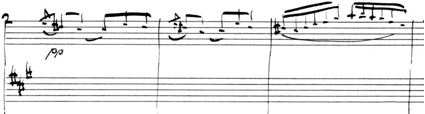
Hall Manuscript, measures 312-314. Courtesy of the New England Conservatory.
Beyond Debussy: An impressive legacy
But it would be unfair to reduce Elise Hall to the Debussy anecdote. Other composers were more professional and saw a real opportunity in her.
- Vincent d’Indy wrote the Choral Varié (Op. 55) for her, a beautiful work that Elise premiered in Paris in 1904 before the Société Nationale de Musique. She was the first woman to play a sax solo in front of the French musical elite.
- André Caplet composed Légende, a technically demanding piece that proves that Elise, despite being an amateur, had a respectable technical level.
- Charles Martin Loeffler and Florent Schmitt also accepted her commissions, creating a musical corpus that gave the instrument a legitimacy it lacked in military bands.
Deafness, criticism and bravery
We need to talk about her deafness. Imagine the difficulty of playing in tune with an orchestra when you can barely hear. Elise used vibrations and her visual knowledge of the score to guide herself. Critics of the time were often ruthless, not so much because of her performance, but simply because she was a woman playing a “masculine” instrument. The Boston press called seeing a woman blowing into a saxophone “grotesque” and “unfeminine.”
But Elise Hall didn’t apologize. She used her privileged position to crack open a hole in the wall of classical music through which thousands of women would later pass. She was the first woman to play as a soloist with the Boston Symphony Orchestra in 1910. That is not just artistic merit; it is an act of political rebellion.
2. Kathryne Thompson: The forgotten teacher who tamed jazz
If Elise Hall represents the struggle for classical repertoire on the East Coast, Kathryne Thompson is the undisputed queen of popular saxophone and jazz on the West Coast. And if Elise’s story is that of a patron, Kathryne’s is that of a tireless worker, a brilliant pedagogue, and a media star who has been unjustly erased.
Thanks to recent research (like Mary Huntimer’s thesis, which we consulted), we now know that Kathryne Thompson wasn’t just a provincial teacher. She was a giant.
From Kitty to Kathryne: Building a career
Born in Illinois in 1889, Kathryne moved to Los Angeles as a young woman. She was lucky enough to study with Edward Lefebre, the star saxophonist of John Philip Sousa’s band, when he visited California. Lefebre saw the talent in that girl who then went by “Kitty” and mentored her.
By the 1920s, Kathryne was no longer a promise; she was a reality. She worked at the Southern California Music Company, where she not only sold instruments but also gave away free lessons with every saxophone purchased. This business strategy allowed her to build a massive student base, which would later feed her more ambitious projects.
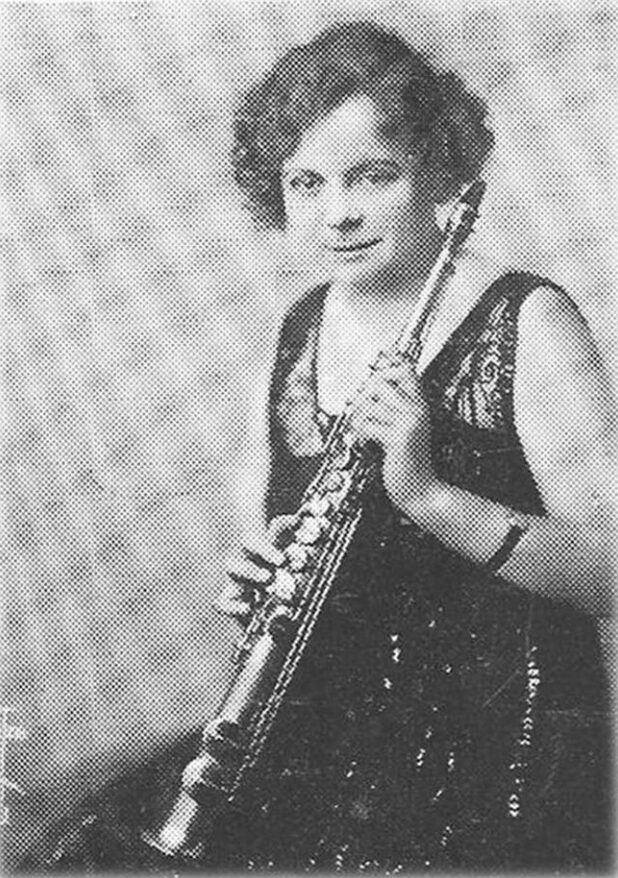
Kathryne Thompson on the cover of “Valse Minah,” bv Kathryne Thompson (Pittsburgh: Volkwein Brothers, 1939)
The first jazz method in history?
Pay attention to this fact, because it rewrites history books. In 1920, Kathryne Thompson published a book titled The Ragtime Saxophonist. At that time, jazz and ragtime were nascent styles, often looked down upon by academics and considered “underworld music.” There were no manuals. You learned by ear. But Kathryne was the first to systematize “ragging” (the art of making rhythmic and melodic variations on a melody).
In her book, she taught how to add passing notes, broken arpeggios, and syncopation to turn a flat melody into a piece with swing. It is highly likely that this is the first jazz pedagogical method for saxophone ever published.
And the funniest part? She had a love-hate relationship with the term “jazz.” In a 1922 interview, she said: “If by jazz we mean the sound of a beginner making the sax sound like a bleating sheep, then I hate it. But well-played ragtime is art.” She argued that to improvise (or “rag”), you first needed flawless technique. Not just anything goes.
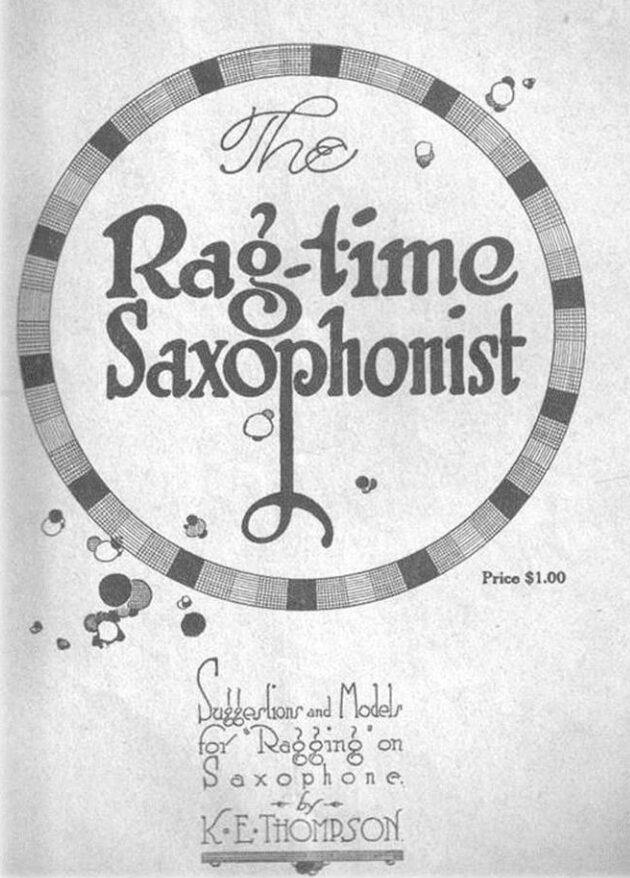
Cover of the Ragtime Saxophonist. Kathryne Thompson (Los Angeles: Kathryne E. Thompson, 1920)
The California Saxophone Army
Kathryne wasn’t satisfied with giving private lessons. She directed the Southern California Saxophone Band, an absolutely monstrous ensemble that grew to 75 members. Can you imagine the sound of 75 saxophones (sopranos, altos, tenors, baritones, and basses) playing in unison? Critics initially mocked it. The Los Angeles Times published a satirical article saying that “if one saxophone is a crime, sixty of them is a holocaust.” But Kathryne silenced them. The band became immensely popular, selling out venues and receiving fan mail from across the country. It was one of the few military/civilian bands of the era that admitted women into its ranks, an unusual fact that Kathryne normalized.
The queen of radio (and the impossible work-life balance)
With the advent of commercial radio, Kathryne became a star of the airwaves. She debuted on KHJ station in 1922 and performed over 80 live shows in five years. The press adored her. Headlines said things like “Make those saxophones behave, Kathryne,” acknowledging her ability to coax a sweet, controlled sound from an instrument that everyone associated with shrill noise.
But the anecdote that best proves her character is about her pregnancy. In 1927, at age 38 (a very advanced age to be a first-time mother at that time), Kathryne continued performing on the radio until her seventh month of pregnancy. She played as a soloist with the Golden State Band live at midnight. When her daughter Caroline was born, the newspaper published the news under the headline “Stork Visits a Musician,” describing Kathryne as a “famous composer and soloist.”
Historical erasure: The Thompson-D’Ippolito case
If Kathryne was so famous, why don’t we know more about her? Because patriarchal history is very efficient at erasing women. Kathryne married Lewis D’Ippolito, a saxophonist from New Jersey who arrived in California years after she was already a star. He started working at her school. But over time, history books and catalogs began referring to her academy as the “Thompson-D’Ippolito School,” and in many later references, his name was put first, or hers disappeared altogether. The reality is that she was the founder, the director, and the star. He joined his wife’s business. But the official narrative has often preferred to present them as a team where he held the baton. Reclaiming the name of the Thompson Progressive School for Saxophone is an act of historical justice.
3. Why are they important today?
This Women’s Day is useless if we only remember the women who appear on banknotes. We must remember the ones who did the dirty work.
Elise Hall teaches us that money can be a revolutionary tool. Without her checkbook and her stubbornness in the face of Debussy’s insults, conservatory students today wouldn’t have the masterpieces of French Impressionism. She endured the disdain of being an “old, deaf woman” because she knew the music was more important than his ego.
Kathryne Thompson teaches us that pedagogy and technique have no gender. She wrote the theory of jazz when men were still fighting over whether it was music or noise. She led armies of saxophones, played on the radio while pregnant, and created a school that trained hundreds of musicians.
The saxophone has never been just for men
Historically, the saxophone has been sold as a hyper-masculinized, aggressive, sexual instrument. But the instrument’s roots are profoundly feminine. Elise and Kathryne were not “anecdotes” or “exceptions.” They were the pillars upon which the building was constructed.
So this 8M, if you have the chance to listen to Debussy’s Rapsodie, don’t think about the French composer grumbling at his desk. Think about Elise Hall, dressed in silk, with her precarious hearing aids, taking the stage in Boston to prove that she, and her instrument, deserved to be heard.
And if you listen to an old jazz solo, remember that maybe, just maybe, that saxophonist learned to “rag” using a book by a woman named Kathryne who lived in Los Angeles and feared nothing.
Exclusive 8M Download:”The Ragtime Saxophonist”
We don’t just want to tell you about history; we want you to see it. To celebrate Women’s Day, we have prepared a special downloadable PDF featuring selected original pages from Kathryne Thompson’s groundbreaking 1920 method, The Ragtime Saxophonist. See for yourself how she taught syncopation, broken arpeggios, and the art of “ragging” before jazz even had an official rulebook.
A special thanks to the research of Dr. Mary Huntimer, whose doctoral thesis “Kathryne E. Thompson: Her Life and Career as a leading saxophonist in Los Angeles from 1900-1927” has been instrumental in bringing Kathryne’s legacy back to light.
Explore more content!
- Top 5 gadgets for Sax PlayElectronic VS Classic Saxophone
- Top 5 Easy Alto Saxophone Songs for Beginners!
- Electronic Saxophones, the ultimate guide!
- Top 5 Youtube channels for Saxophonists!
- How to play the saxophone without disturbing your neighbors?
- Travel Instruments, every musician must know
Happy reading!
Odisei Music Team